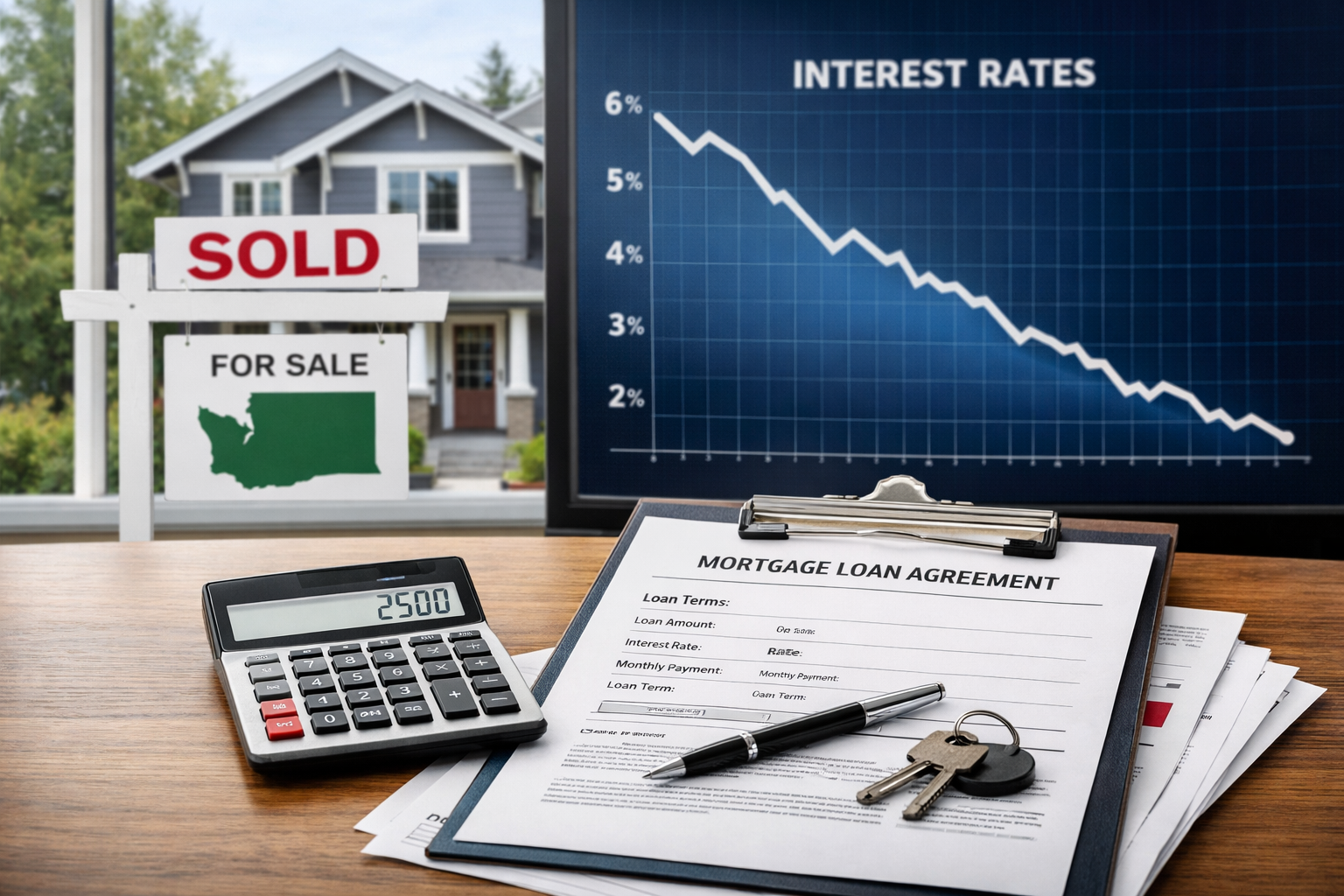
In 2026, with mortgage rates in Washington showing continued fluctuation following several years of economic unpredictability, homebuyers are searching for ways to lock in savings. One often misunderstood strategy is buying mortgage points to reduce the interest rate on a home loan. But is it worth it?
This guide breaks down everything you need to know about mortgage points, with a special focus on Washington’s housing market and current rate environment.
What Are Mortgage Points?
Mortgage points, also known as discount points, are fees you can pay upfront to lower the interest rate on your mortgage. Each point typically costs 1% of your loan amount and reduces your rate by approximately 0.25%, though this can vary by lender.
For example, if you’re borrowing $500,000, one point would cost $5,000. In exchange, your lender might offer you an interest rate reduction of 0.25%.
How Do Mortgage Points Work?
Think of mortgage points as a trade-off: you pay more upfront to save money over time. By reducing your interest rate, you lower your monthly payments and potentially save thousands over the life of the loan.
Key benefits include:
- Lower monthly mortgage payments
- Significant long-term interest savings
- Improved affordability over time
However, they only make financial sense if you plan to stay in the home long enough to recoup the upfront cost.
The Cost of Buying Mortgage Points
Each point costs 1% of the total loan amount:
- $400,000 loan = $4,000 per point
- $600,000 loan = $6,000 per point
- Some lenders allow you to purchase fractions of a point. You might not need to buy a full point to see some rate reduction.
It’s essential to calculate the breakeven point, the number of months or years it takes for your monthly savings to equal the upfront cost.
Fixed-Rate vs. Adjustable-Rate Loans and Points
Mortgage points can be applied to both fixed-rate and adjustable-rate mortgages (ARMs), but the impact varies:
- Fixed-Rate Mortgages: Points reduce your rate for the entire loan term.
- Adjustable-Rate Mortgages: Points may only reduce the rate during the initial fixed period.
In 2026, with more Washington buyers exploring ARMs due to rate volatility, it’s crucial to understand this distinction.
Mortgage Points in Washington: What Makes Our Market Unique
Washington’s real estate market presents unique factors:
- Higher-than-average home prices in areas like Bellevue and Seattle
- Volatile interest rates post-pandemic and amid global economic uncertainty
- Local lender competition offering varying discounts and incentives
These dynamics make mortgage points potentially more valuable in Washington than in lower-cost states.
Should You Buy Mortgage Points in 2026?
Here are ideal conditions for buying points in the current market:
- You plan to stay in the home long-term (7+ years)
- You have extra cash available at closing
- You want to reduce monthly obligations
- You qualify for a competitive base interest rate
On the flip side, points may not make sense if you’re:
- Unsure about how long you’ll stay in the home
- Already stretching to cover closing costs
- Expecting to refinance soon
Breakeven Analysis: How Long Does It Take to Recoup the Cost?
To calculate your breakeven point:
- Determine the cost of the points
- Calculate the monthly savings from the reduced interest rate
- Divide the cost by the monthly savings
Example:
- $500,000 loan
- 1 point = $5,000
- Rate reduction saves $100/month
- $5,000 / $100 = 50 months = ~4.2 years
If you stay longer than 4.2 years, you start saving money.
Real-Life Examples: Washington Buyers in Different Scenarios
First-Time Buyer in Bellevue: Buys a $700,000 home with 10% down. Plans to stay 10+ years. Buys 2 points for $12,600, reducing monthly payments by $180. Breakeven in 5.8 years.
Military Buyer Using VA Loan in Tacoma: Low base rate already, no need to buy points. Instead, uses savings for moving expenses.
Investor Buying in Spokane: Purchasing a duplex with rental income. Buys down rate to increase cash flow. Points provide ROI within 3 years due to high rental yield.
When NOT to Buy Mortgage Points
Avoid points if:
- You expect to refinance or sell in the near future
- You’re using down payment assistance or seller-paid closing cost programs
- Your monthly savings don’t justify the upfront cost
For some Washington buyers, using the funds for repairs or renovations may offer a better return.
Alternatives to Buying Down Your Rate
- Make a larger down payment to reduce principal
- Shop around for better lender offers
- Use a shorter loan term (like 15 years) for lower rates
- Negotiate seller credits instead of price reductions
How to Decide: Questions Every Buyer Should Ask
- How long do I plan to stay in the home?
- Do I have extra cash to pay for points without impacting my emergency fund?
- What is the breakeven timeline?
- Are current interest rates likely to fall soon (making refinancing a better path)?
- Is the lender offering competitive pricing on points?
How Mortgage Points Affect Loan Underwriting and Approval
Buying mortgage points can influence the underwriting process in both positive and negative ways. On the positive side, paying points may reduce your debt-to-income (DTI) ratio due to the lower monthly payment, potentially improving your mortgage eligibility.
However, the added upfront cost must be documented as a verified source of funds, and the underwriter will ensure you’re not depleting your reserves or cash needed for other closing costs. Some automated underwriting systems (AUS) may also factor in points when assessing risk-based pricing.
In Washington, where many borrowers use down payment assistance, the source of funds for points must be clarified, especially if gift funds or seller contributions are involved.
Comparing Lender Offers: How Points Vary Between Institutions
Not all lenders offer the same value for mortgage points. One lender might offer a 0.25% rate reduction per point, while another might offer 0.375% for the same cost. Additionally, some lenders limit the number of points you can buy.
Always request a Loan Estimate from multiple lenders and compare:
- The cost per point
- The rate reduction per point
- The total loan costs over 5, 10, and 30 years
In Washington, credit unions, national banks, and local mortgage brokers may all have different pricing models. Comparing offers could save you thousands.
Using Seller Concessions to Pay for Mortgage Points
In a buyer’s market or slower season, Washington sellers may be more willing to offer concessions that can be used to pay mortgage points. These concessions are negotiated as part of your purchase agreement and must comply with loan program limits.
For example:
- Conventional loans allow up to 3% concessions for down payments under 10%
- FHA allows up to 6%
- VA allows up to 4%
Using seller concessions to fund points can be a strategic way to reduce your long-term costs without dipping into your own savings.
Refinancing with Points: When It Makes Sense (and When It Doesn’t)
You can also buy points when refinancing. If you’re reducing your rate or switching to a different loan term, paying points might deepen your savings. However, the same breakeven math applies.
Refinancing with points makes sense when:
- You plan to stay in the home long-term
- The new rate after points is significantly lower
- You’re switching from an ARM to a fixed-rate loan
It might not make sense if:
- You plan to move again soon
- You’re already at a low rate
- You’re cashing out equity and want to minimize upfront costs
How to Negotiate the Best Deal on Mortgage Points
Smart buyers negotiate everything, including points. Start by shopping multiple lenders. Then:
- Ask each for their best pricing on points
- Request lender credits if you’re not paying for points
- Leverage any pre-approvals or competitive offers
- Inquire about promotions for buying down rates
Your loan officer may have discretion on how many points they offer and what the corresponding rate reduction is. A strong credit profile and good relationship with your lender can go a long way in improving your terms.
Mortgage Points and Jumbo Loans in Washington
Jumbo loans, which exceed conforming loan limits, are common in high-cost Washington areas like Bellevue, Seattle, and Redmond. These loans often come with higher interest rates and stricter underwriting requirements. Buyers seeking jumbo financing might find even more value in mortgage points due to the large loan size.
For example, if you’re borrowing $1.2 million, one point would cost $12,000. If that reduces your interest rate by 0.25%, your monthly payment could decrease by hundreds of dollars, and savings over 10 years could exceed $25,000.
Considerations when buying points on a jumbo loan:
- Ensure you have sufficient liquidity; lenders will review your post-closing reserves
- Jumbo loans may allow more flexible point structures or negotiated rate buy-downs
- Ask your lender for tiered options: 1, 1.5, or 2 points with corresponding rate changes
While jumbo borrowers often focus on short-term savings, those with a long-term horizon can use mortgage points to dramatically cut long-term interest costs.
Final Thoughts: Are Mortgage Points Right for You?
Mortgage points can be a powerful tool to reduce your long-term borrowing costs, but only when used strategically. In Washington’s 2026 market, with its rate unpredictability and high home prices, buying down your rate may be a smart move if you plan to stay put and have the upfront funds.
Talk with a trusted lender to explore your options and compare breakeven scenarios. Mortgage points aren’t for everyone, but for some Washington buyers, they can unlock meaningful savings.
FAQs
Are mortgage points worth it in 2026?
Yes, if you plan to stay in the home long-term and can afford the upfront cost, mortgage points can reduce your interest rate and save thousands over the life of the loan.
How do I calculate if mortgage points are a good deal?
Divide the cost of the points by the monthly savings to find your breakeven point. If you’ll stay longer than that, the points usually pay off.
Can I buy mortgage points with a VA or FHA loan in Washington?
Yes, both VA and FHA loans allow mortgage points, but each has specific rules. VA loans already offer favorable rates, so points may not add value.
Are mortgage points tax deductible?
In many cases, yes. Discount points used to buy down your interest rate may be tax deductible. Consult a tax professional for your specific situation.
How do mortgage points affect my closing costs?
Mortgage points increase your closing costs because they’re paid upfront. Make sure you have sufficient funds or explore seller concessions to offset them.